The moment humans began to exchange goods, write records, and trust one another, fraudulent activity existed. In every era, fraud found a way to wear a mask, disguised as something legitimate, but hiding danger inside.
Financial crime is a global-scale risk. Not only for the businesses but also for society. Every missed check can enable fraud, corruption, or exploitation. Compliance protects real people and the wider economy. Done well, it stops illicit funds from entering the financial system, blocks account takeovers, and disrupts organized criminal activity. For banks, robust compliance mitigates legal exposure, reputational damage, operational disruption, and the loss of customer trust. For society, it reduces the flow of funds tied to corruption, trafficking, and other serious crimes.
At Sopra Steria Bulgaria, we turn compliance into a proactive shield for banks in Germany and their clients across the globe, combining regulatory expertise with advanced technology. Our AFC & Compliance team helps banks prevent, detect, and report financial crime so institutions can protect clients, uphold integrity, and operate with confidence.
What is regulatory compliance in Germany?
Germany is home to one of Europe’s most tightly regulated financial markets. Institutions like the BaFin, Deutsche Bundesbank, and the European Central Bank enforce laws to prevent financial crime and ensure stability.
Key regulations include:
- Banking Act (KWG): Governs licensing and risk management
- Money Laundering Act: Regulates preventive measures against using the financial system for money laundering
- Securities Trading Act: Covers investment services, data reporting, abusive trading
- EU’s Digital Operational Resilience Act: DORA - strengthen the digital resilience of financial entities and create a framework
- Policies and procedures such as Risk Assessment, monitoring, reporting, continuous improvement, and employee engagement
Some of the Key Practices for Financial Institutions are implementing comprehensive compliance programs, conducting regular trainings, using advanced technology, maintaining accurate and up-to-date records, establishing a dedicated compliance team, engaging in proactive, holistic risk management, conducting external audits and assessments, and having a robust crisis compliance awareness and GDPR.
What happens when banks fail to comply?
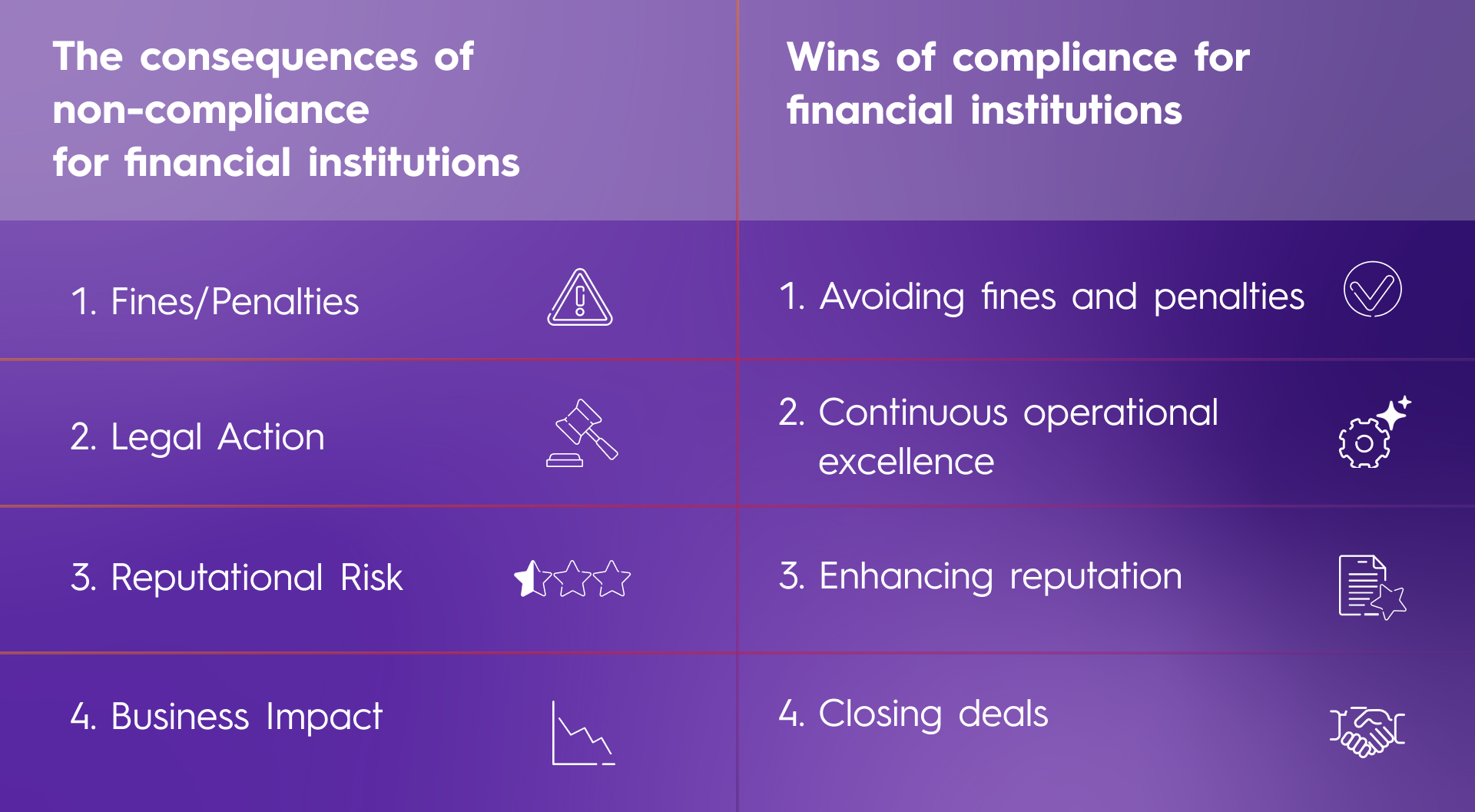
Non-compliance can result in heavy fines, loss of operating licenses, reputational damage, and customer distrust. On the other hand, compliance builds credibility and protects banks from being exploited for money laundering or fraud.
Having outlined the regulatory landscape and the consequences, let’s see how Sopra Steria operationalizes these principles.
How Sopra Steria Bulgaria helps banks stay compliant
Our AFC & Compliance team supports banks in Germany and beyond by monitoring suspicious transactions and maintaining the highest compliance standards.
What our AFC (Anti-Financial Crime) team does to stop and prevent crime is:
- Anti-Money Laundering (AML)
- Know Your Customer (KYC)
- Anti-Fraud Management (AFM)
The KYC domain includes identifying PEP (politically exposed person), Blacklisted, and Sanctioned individuals, making a classical KYC data comparison. This could involve sanctioned individuals or entities, various national blacklists/credit bureau lists, etc. This process is especially important to ensure there are no disreputable, politically involved parties and no criminals are trying to open a bank account. While the KYC process is imperative to stop illicit entry attempts at the bank, the AML compliance prevents the influx of illegitimate funds into the legitimate financial system. The procedure involved analysis, decision-making, and further processing, including the submission of a Suspicious Activity Report (SAR). Within this domain, our team deals with sanctions hits in transaction counter parties, authority requests: investigation of affected customers, and other internal escalation (referral) cases, including terrorism financing, account takeover, etc.
The Anti-Fraud Management compliance is responsible for alert analysis for potential fraudulent activities. This includes transactions recall alerts ID theft / Account takeover (ATO) alerts based on holistic customer profiles, device logins, and AFC history.
How do we help banks maintain client security and brand integrity?
We halt transactions or freeze accounts when risk thresholds are met, minimizing financial losses for clients and ensuring alignment with regulatory obligations. We keep pace with evolving risks through regular training, real‑case knowledge sharing, and continuous process reviews. We strengthen internal controls, data security, and reporting, and we cultivate a team culture where people can set boundaries, suggest improvements, take ownership, and grow.
Incorporating digital solutions, including AI tools, makes the compliance process more efficient and accurate. These tools help us identify patterns, automate monitoring, risk assessment, policy enforcement, and train ourselves to become even more effective in our jobs.
With that foundation in place, here’s what this looks like in practice.
Our Direct Impact: Real case stories of prevention
Our service was founded in 2021, and so far, we have dealt with a multitude of cases, but there are a few that marked our work and give the highest satisfaction and meaning, being impactful and life-changing.
Elitsa Vasileva:
A company account showed a high‑value booking with no legitimate business purpose. When the source of funds couldn’t be substantiated, we escalated and stopped further activity. Early detection and decisive escalation protected corporate assets and the bank’s reputation.
Yordan:
The world of finance has drastically changed over the last several years. Money has become a vital resource for crime. To circumvent international sanctions, shell companies, zombie accounts, and victims of account takeover have become common tools. Our client, who received funds from a family member, explained that he wishes to invest in real estate and that the funds are accumulated from his salary. This seemed plausible. However, we discovered that the father had worked in the past for a sanctioned software company and is likely acquainted with various sanctioned individuals. Through its agents – the sanctioned individuals, the father of our client, and our client – could possess the account and use it to spread corruption, political messages, and shape the fabric of our societies. The client stated that he expects 500,000 EUR to arrive on the account. Given the risk and the broader implications, we decided to terminate the relationship and prevent the possibility of the account being used as a channel for indirect state influence or financial misconduct.
Deyvid:
An account was flagged after receiving over 237.000,00 € in just six months from the adult entertainment industry. At first, it looked like a freelance income. But after a deep dive into the case, the story changed: the account was not for a legitimate business but was potentially a financial front for a sophisticated operation with strong evidence of human trafficking and child exploitation. The account holder used anonymizing tools to cover their tracks while sending small payments to Cagayan De Oro, a city in the Philippines, which is a known global hotspot for human trafficking and, specifically, child cyberprostitution. This pattern - vast profits on one end and minimal payments to people in a high-risk area on the other - is textbook example of trafficking cases. By allowing this, we would not only expose the institution to legal and reputational damage but also enable the abuse of vulnerable people. So, immediate action was taken - the account was frozen, the relationship with the customer was terminated, and the account holder was reported to the relevant authorities. This case highlights the importance of the compliance work. It’s not just about rules and regulations but about protecting the vulnerable.
Theodor:
In our daily work we see and report various bad intentions, financial fraud being the least dangerous. We are talking of child exploitation cases, people who committed suicide because they were misled to invest their fortune into a fraudulent scheme, terrorist acts being prepared and financed. Sometimes we only report after the crimes, but in many instances, we can spot them while happening or even before that, and report to the relevant authorities, who can take legal action. It is often the dark side of human nature we are dealing with, but it's the good side who benefits, so it's a reason to be proud :)
What can you take away?
Compliance is more than policy—it’s purpose. At Sopra Steria Bulgaria, our work is global and meaningful. We empower banks to act with integrity and individuals to make safer financial choices.
And we have a lot to offer, whether it would be a trusted compliance partner or a professional looking to join a growing AFC team, or just knowing how to protect your money better, we will be happy to talk. Connect with us on LinkedIn, Instagram, YouTube, or Facebook pages to stay inspired and informed.
AFC and Compliance Service offering
Careers